
Fayette County Property Tax Records
Fayette County property tax records are kept by the county Auditor, Assessor, and Treasurer, all based in Connersville. These offices work together to track parcel ownership, set assessed values, apply deductions, and issue tax bills each year. Property owners in Fayette County can search records online through the county's DataPitStop portal or through Indiana's statewide Gateway system. Both tools give access to parcel numbers, owner names, tax amounts, and payment history without needing to visit the courthouse on Central Avenue.
Fayette County Property Tax Quick Facts
Fayette County Online Property Tax Search
The Fayette County Auditor runs a DataPitStop portal that lets you look up property tax records at any time of day. The search is available at auditor.fayettecounty21.us. You can search by parcel number, owner last name, or property address. When searching by name, enter just the last name first for the widest set of results. A partial address often works better than typing the full street name with its suffix attached.
The portal shows detailed property tax records that include parcel numbers, owner names, property addresses, assessed values, deduction amounts, and current tax bill totals. This is the main county-level tool for Fayette County property research. For a second option, the Indiana Gateway Tax Bill Lookup covers all Indiana counties and can serve as a backup when the county portal is slow or down. GIS mapping for Fayette County also runs through the DataPitStop system, so parcel boundaries and ownership data are visible alongside the tax figures.
Fayette County Auditor Office
The Fayette County Auditor is located at the Fayette County Courthouse, 401 N. Central Ave, Connersville, Indiana 47331. The main phone is 765-825-8987 and the fax is 765-827-4936. You can also reach the office by email at auditor@co.fayette.in.us. The full county website is available at co.fayette.in.us/auditor.
The Auditor's primary role in the property tax process is maintaining the tax duplicate, processing deed transfers, and managing deduction filings. When a parcel changes ownership, the deed transfer goes through the Auditor first. Deductions tied to the prior owner do not carry over on their own. The new owner must file separate applications to claim any deductions they qualify for under Indiana law. The Auditor's office also works alongside the county Assessor, who sets property values that feed into the tax calculation.
The county auditor portal at auditor.fayettecounty21.us provides the main access point for online property tax data in Fayette County. The site is maintained separately from the state Gateway but covers the same core parcel and billing data.
Fayette County Property Tax Deductions
Indiana law under IC 6-1.1-12 provides a range of deductions that lower the assessed value used to calculate your tax bill. Fayette County property owners file all deduction applications with the Auditor at 401 N. Central Ave. The most widely used deduction is the homestead deduction, which applies to a primary residence. A supplemental homestead deduction can stack on top of the base amount for additional savings.
Other deductions available in Fayette County include the Over 65 deduction, the Over 65 Circuit Breaker, deductions for blind or disabled property owners, and the Totally Disabled Veteran deduction. If you have installed a geothermal or solar energy system on your property, you may also qualify for a separate energy-related deduction. All applications must reach the Fayette County Auditor by January 5 of the year following the assessment date. Miss that date and you will need to wait a full year to get the benefit applied.
Deductions do not renew automatically after a property sale. If you buy a home in Connersville or elsewhere in Fayette County, confirm which deductions are active on the parcel and re-file for any you qualify for. The Auditor can walk you through each form.
Assessment and Valuation in Fayette County
All property in Fayette County is assessed as of January 1 each year under IC 6-1.1-4. The county Assessor determines the assessed value, which under Indiana code is set at market value for most property types. Land and improvements are valued separately and then combined to produce the total assessed value shown on your tax records. The tax bill you receive is based on that assessed value minus any approved deductions, multiplied by the applicable tax rate for your taxing district.
If you believe your assessed value is wrong, Indiana gives you the right to appeal. File Form 130 with the Fayette County Property Tax Assessment Board of Appeals by June 15. The appeal process is governed by IC 6-1.1-35. If the local board does not resolve your appeal to your satisfaction, you can escalate to the Indiana Board of Tax Review and, after that, to the Tax Court. Keep copies of everything you submit and note all deadlines, because missing a filing window closes that appeal path.
Fayette County Tax Bill Payment and Due Dates
Property taxes in Fayette County are paid in two installments each year. The spring installment is due May 10 and the fall installment is due November 10. Payments go to the Fayette County Treasurer, also located at the courthouse on Central Avenue in Connersville. If May 10 or November 10 falls on a weekend or holiday, the due date shifts to the next business day.
Missing a payment date triggers penalties under Indiana code. A 5% penalty applies within the first 30 days after the due date. After 30 days, the penalty rises to 10%. These charges add directly to the tax bill and must be paid before the account is considered current. The Treasurer's office can tell you the exact amount owed including any penalties that have accrued. For current payment status and bill amounts, use the Indiana Gateway Tax Bill Lookup or the Fayette County Auditor portal.
Taxpayers who let taxes go unpaid for multiple years risk a tax sale, where the county offers the delinquent parcel to outside buyers. Catching up on back taxes before a sale is always the better path. Contact the Treasurer at 765-825-8987 to discuss your options if you are behind.
Statewide Indiana Resources for Fayette County
The Indiana Department of Local Government Finance, known as the DLGF, oversees the property tax system for all 92 Indiana counties including Fayette. The DLGF sets the rules for assessments, deductions, tax rates, and billing timelines. You can reach the DLGF at their website in.gov/dlgf or by phone at (317) 232-3777. The department publishes plain-language guides on how assessed values work, what deductions exist, and what your rights are as a property owner.
The Indiana Gateway for Government Units provides public access to budget and tax rate data for every county. The assessed value search at in.gov/dlgf lets anyone look up assessed values statewide. Beacon GIS at beacon.schneidercorp.com offers an additional parcel search tool that covers many Indiana counties, including supplemental map views and ownership history.
The screenshot below shows the DLGF homepage, the state agency that governs all Indiana property tax rules and sets standards that Fayette County must follow.
The Indiana DLGF homepage, available at in.gov/dlgf, serves as the central state resource for all Indiana property tax guidance.

The DLGF site includes tax rate notices, assessment rules, and contact information for every county's local government units.
Fayette County Auditor Portal Screenshot
The Fayette County Auditor's online portal, hosted at auditor.fayettecounty21.us, is the direct source for county property tax records and parcel data.
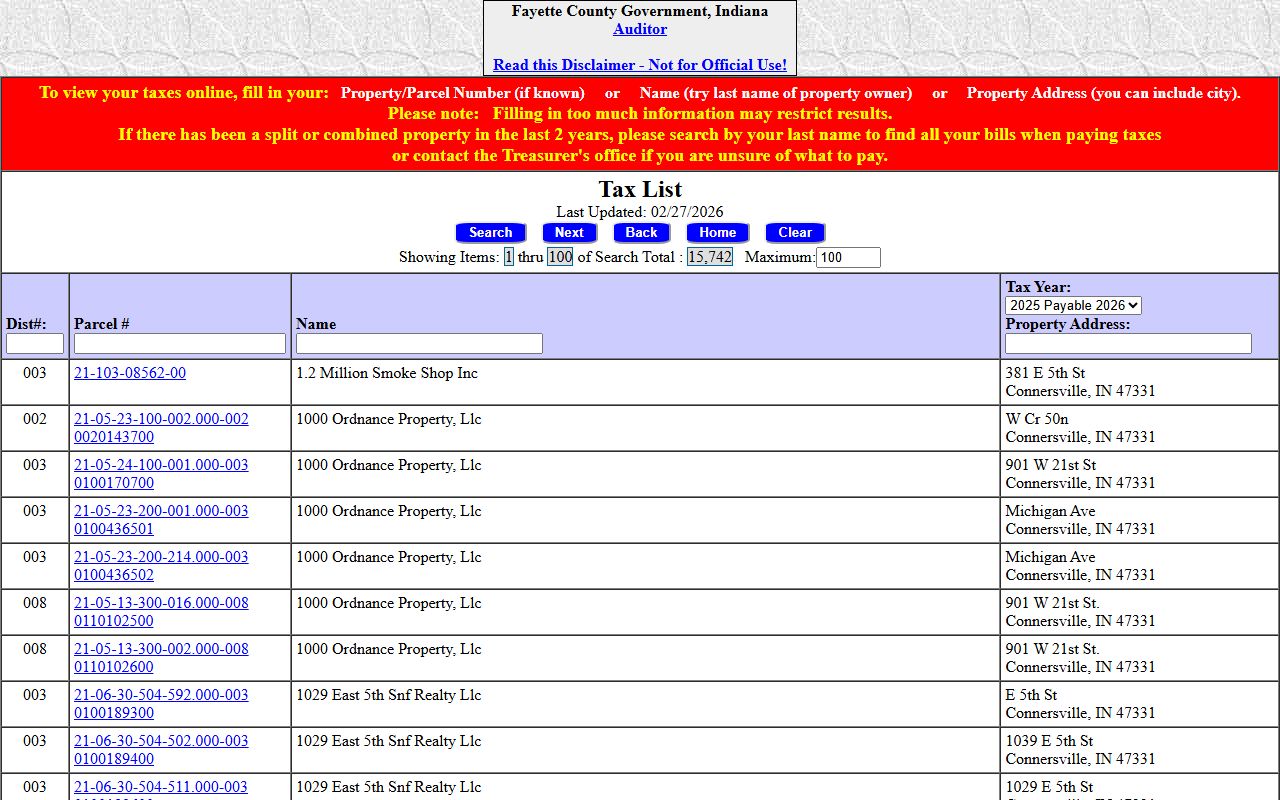
The portal allows searches by parcel number, owner name, or address and returns detailed tax records including assessed values, deductions, and bill amounts.
Key Laws Governing Fayette County Property Taxes
Indiana Code Title 6, Article 1.1, found at law.justia.com, is the primary body of law for property taxes in Indiana. Several chapters within that article are especially relevant to Fayette County property owners. IC 6-1.1-4 covers the assessment process and how values are determined. IC 6-1.1-12 lists every available deduction and the eligibility rules for each. IC 6-1.1-22 governs how tax bills are issued and what payment timelines apply. IC 6-1.1-35 controls the appeals process from the local board up to the Tax Court.
These statutes apply uniformly across Indiana but are administered locally by Fayette County offices. The DLGF issues guidance and rules that county officials must follow. When a question about your tax bill or assessed value cannot be resolved at the local level, the DLGF and Indiana Board of Tax Review serve as the next step. Knowing which law applies to your situation helps you frame questions clearly when you contact the Auditor or Assessor.
Nearby Counties
Fayette County borders several counties in east-central Indiana. Each has its own Auditor and property tax search tools.