
Indiana Property Tax Records
Indiana property tax records are public documents held by county Assessors, Auditors, and Treasurers across all 92 counties. You can search Indiana property tax records online by parcel number, owner name, or property address through official state and county portals. The Indiana Department of Local Government Finance oversees the system and maintains statewide databases. This guide covers how to find, view, and access Indiana property tax records at the state and local level.
Indiana Property Tax Quick Facts
How Indiana Property Tax Records Are Maintained
Property taxes in Indiana run through three offices at the county level. The County Assessor values your property each year. The County Auditor calculates the tax bill, handles deductions, and manages exemptions. The County Treasurer collects payments and enforces due dates. These three offices work together but handle different questions. If you want to know why your assessed value went up, contact the Assessor. For deduction questions, call the Auditor. For payment amounts or due dates, the Treasurer is the right contact.
The legal foundation for Indiana property taxes is IC Title 6, Article 1.1, which covers everything from definitions and assessment procedures to deductions, billing, tax sales, and appeals. Under IC 6-1.1-1, January 1 is the official assessment date. Property taxes are based on the value of your property as of January 1 of the prior year. Tax bills cover the previous year's assessment, so there is always a one-year lag. Bills are mailed once a year, typically in early April, with coupons for both installments included in the same envelope.
The Indiana Department of Local Government Finance, or DLGF, oversees all 92 counties. Their office is at 101 W. Ohio Street, Suite 1200, Indianapolis, IN 46204. Phone: (317) 232-3777. Email: Data@dlgf.in.gov. The DLGF sets the rules for assessments, reviews budgets, and certifies tax rates statewide. They also run several free online databases that let you look up tax bills, assessed values, and property information without visiting a county office.
Indiana DLGF - State Property Tax Authority
The Indiana Department of Local Government Finance is your starting point for statewide property tax information. The DLGF website has educational guides, data compliance reports, links to county tax search tools, and access to the Indiana Gateway system. They also publish certified tax rates for every taxing district in Indiana, which you can use to understand how your bill is calculated.
The DLGF states on their data portal: "The information provided in these databases is public record and available through public information requests. The Department of Local Government Finance has compiled this information in an easy-to-use format to assist Hoosiers in obtaining information about property taxes." They note that since the data comes directly from each county, "some formatting and other errors may be present." If something looks wrong on the DLGF site, they recommend contacting your county auditor to verify.
The Indiana DLGF homepage gives access to statewide property tax databases, rate information, and county-level data.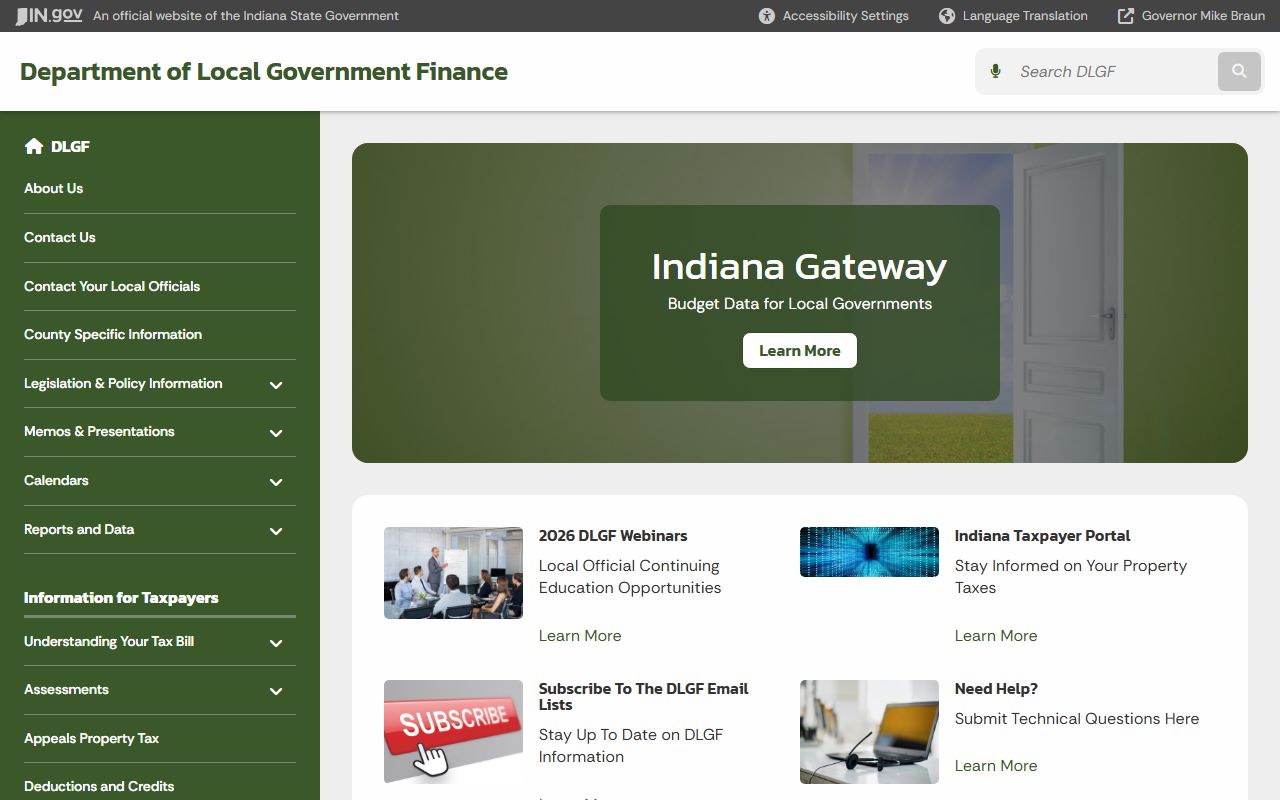
The DLGF also maintains a Data Compliance section under Rates, Reports and Data. If your county's data is not yet showing in the statewide search tools, this section tells you the status of each county's submission.
Search Property Tax Records on Indiana Gateway
The Indiana Gateway for Government Units Taxpayer Portal is a free statewide tool for Indiana property owners. It includes six key features: a Tax Bill Estimator, a Referendum Impact Calculator, a Sales Disclosure Search, a Tax Bill Lookup Tool, an Assessed Value Lookup Tool, and Budget Notices. Most tools let you search by taxpayer name or property address, so you do not need to know your parcel number ahead of time.
The DLGF offers several search tips for this portal. Try a partial search using only the street name, leaving out direction or type. You can also search by part of your last name alone instead of your full name. Swapping the order of first and last name sometimes returns results when a full name search fails. Adding a middle initial between your first and last name is another option if results are not showing up. These tips apply to the Gateway tools and many county-level search portals as well.
The Indiana Gateway Taxpayer Portal provides free access to tax bill estimates, assessed values, sales disclosures, and budget notices for all Indiana counties.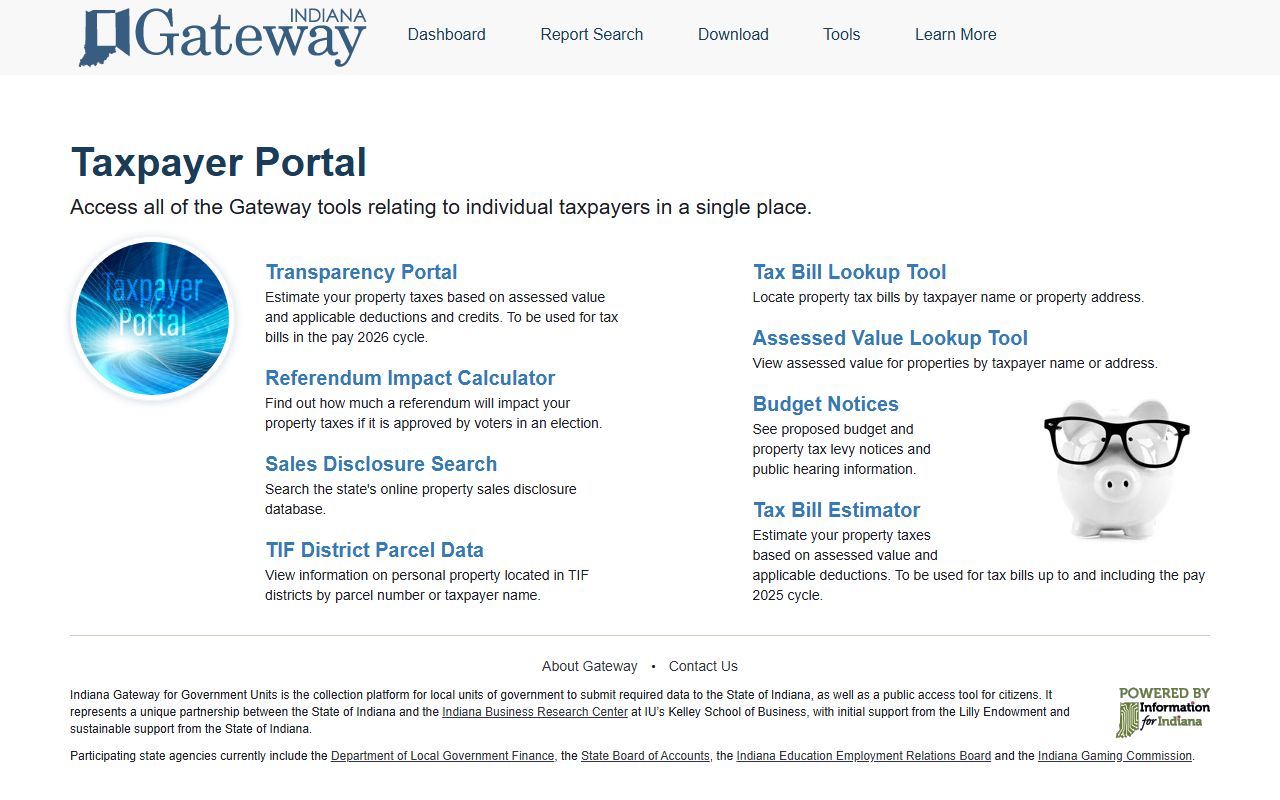
The Indiana Gateway Tax Bill Lookup is a focused tool for finding your tax bill directly. Search by name or address to view both the spring and fall installment amounts for your parcel.
Use the Indiana Gateway Tax Bill Lookup to find your current and prior year property tax bills by name or address.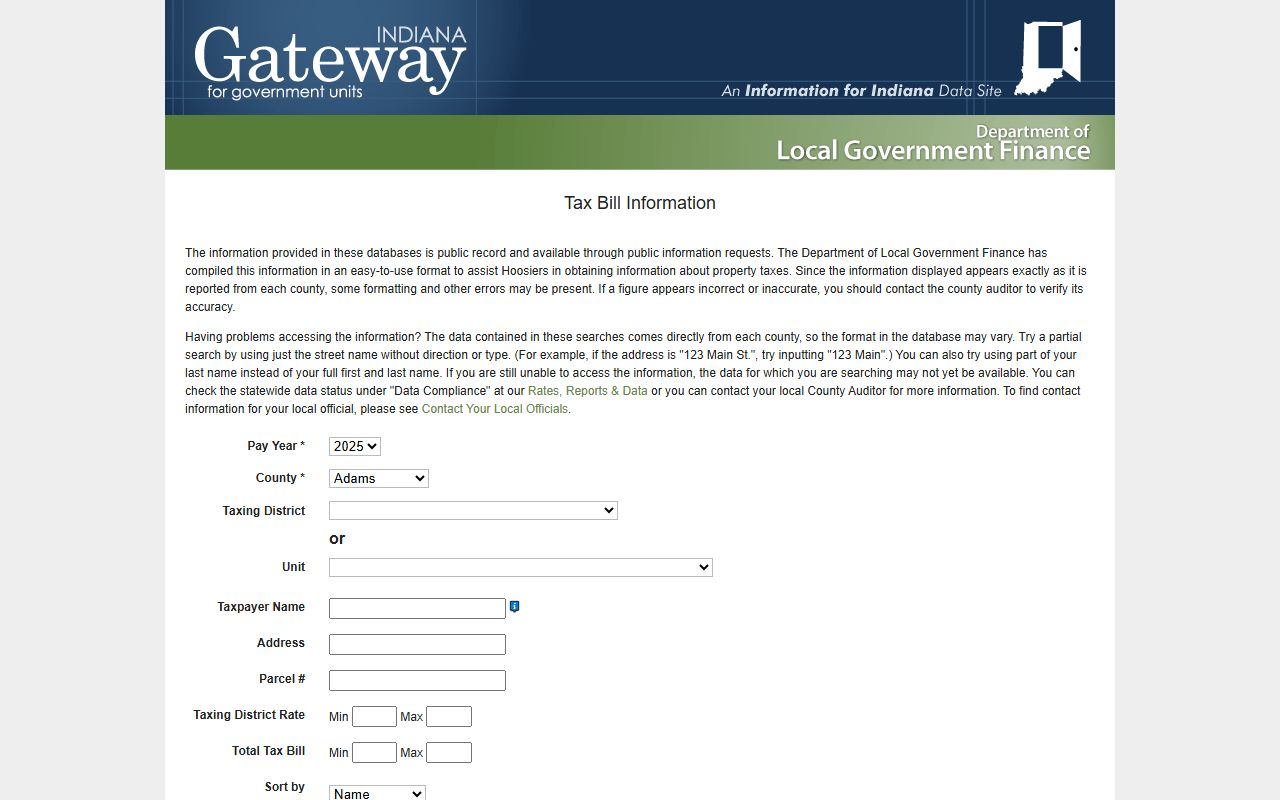
Look Up Indiana Property Assessed Values
The DLGF Assessed Value Search is a separate tool for viewing assessed values by taxpayer name or property address. When using this tool, look for the row marked "Assessed Value Total Land and Improvements" which is highlighted in yellow in the results table. This is the number your tax bill is based on. The tool also includes a download button so you can export the data to an Excel file if needed.
One important concept to understand: the assessed value for a given year is what drives the taxes you pay the following year. The DLGF explains it clearly: "the assessed value for a particular year (for instance 2025) is the value upon which taxes are based in the following year (i.e. 2026)." Under IC 6-1.1-4, Indiana law requires cyclical reassessment of all real property. Assessors update values on a rolling schedule to keep them current. When your value changes, a Notice of Assessment (Form 11) is mailed by April 30.
The DLGF Assessed Value Search shows current and historical assessed values for properties across all 92 Indiana counties.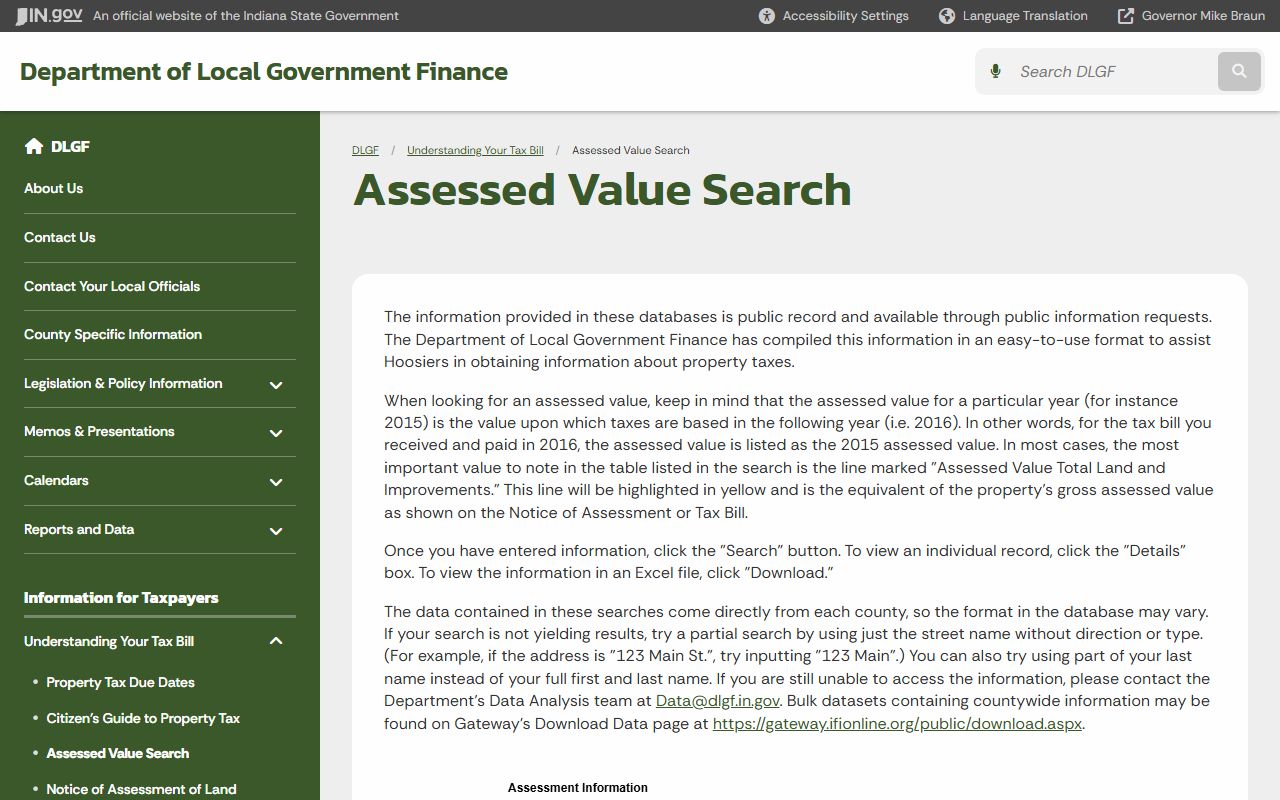
Indiana Property Tax Deductions
Indiana law provides several deductions that reduce the assessed value used to calculate your property tax bill. Deductions are administered by the County Auditor, not the Assessor or Treasurer. Most deductions must be applied for, and the deadline to file is January 5 of the year following the assessment year. IC 6-1.1-12 governs all standard deductions including Homestead, Over 65, disability, and veteran deductions.
The Homestead Deduction is the most widely used deduction in Indiana. It applies to your primary residence. Once filed, it stays active as long as you remain in the home and continue to qualify. Boone County's Auditor notes that "the only deduction that needs updating when refinancing is the mortgage deduction. Homestead deductions stay active for as long as you stay in your home and qualify." However, if you change your deed for any reason, including refinancing or adding a name, you need to re-file your deductions. Clark County warns specifically: "If you change your deed in any way, please come in to re-file your deductions. Failure to do so will result in losing your deduction." Filing for the Homestead Deduction requires the last five digits of your Social Security Number for each person residing at the property.
Common Indiana property tax deductions include:
- Homestead Standard Deduction
- Homestead Supplemental Deduction
- Over 65 Deduction
- Over 65 Circuit Breaker
- Blind or Disabled Deduction
- Totally Disabled Veteran Deduction
- Geothermal, Solar, Wind, and Hydroelectric Deductions
St. Joseph County recently added a new Over 55+ Tax Credit for residents who are 55 or older, have held a Homestead Deduction in the prior year, and have lived in the property for at least 10 years. There is no income limit for this credit. It is available for three years. Many Indiana counties have also expanded eligibility for Over 65 and disability deductions following recent legislation, so it is worth contacting your County Auditor even if you were previously told you did not qualify.
Property Tax Payments and Due Dates in Indiana
Indiana property taxes are due in two equal installments. IC 6-1.1-22 sets the standard due dates as May 10 for the spring installment and November 10 for the fall installment. If either date falls on a weekend or holiday, the due date moves to the next business day. Most counties send one tax bill in early April containing payment coupons for both installments. Not receiving a bill does not excuse late payment. Monroe County's Treasurer puts it directly: "Failure to receive a tax statement does not relieve the taxpayer of the responsibility for payment and penalties when delinquent."
The late payment penalty is 5% of the unpaid tax if paid within 30 days of the deadline, and provided there are no prior delinquencies. After 30 days, the penalty increases to 10%. Bartholomew County states it simply: "If an installment of taxes is not completely paid on or before the date, a penalty equal to five percent (5%) for the first thirty days (30), then an additional five percent (5%) thereafter." Properties with unpaid taxes for multiple years may become eligible for tax sale under IC 6-1.1-24.
Most Indiana counties accept payment online, by phone, by mail, in person, via drop boxes, and through participating local banks. Online payments typically carry a convenience fee of 2.4% to 2.95% for credit and debit cards. E-check fees are usually $1.25 to $2.00. Some counties offer auto-payment or recurring payment plans through their online portals.
Appealing Your Indiana Property Tax Assessment
If you think your assessed value is too high, Indiana law gives you a clear process for challenging it. Under IC 6-1.1-35, you start by filing a Form 130 with your County Assessor. The standard deadline is June 15, though individual counties may post different dates on their Form 11 notices. The Form 130 triggers a review by the PTABOA, which stands for Property Tax Assessment Board of Appeals. Every Indiana county has one. The PTABOA holds hearings, reviews evidence, and issues written decisions. If you disagree with the PTABOA ruling, you can appeal to the Indiana Board of Tax Review (IBTR). Putnam County notes that "the IBTR addresses appeals contesting real and personal property assessments" and provides a separate avenue outside the county system.
Assessors use three methods to value property: cost approach, income approach, and sales comparison approach. Marshall County's assessor states: "The County Assessor is responsible for accurately and uniformly determining the market value-in-use of every property in Marshall County as of January 1 of the current year. This is achieved by using three approaches to value: 1) Cost, 2) Income, 3) Sales Comparison." Understanding which method your assessor used can help you prepare a stronger appeal.
Property Tax Search Platforms Used Across Indiana Counties
Indiana counties use several different software platforms for online property tax records. Knowing which system your county uses helps you find the right search tool faster.
Beacon by Schneider Corp is the most widely used GIS and property search platform in Indiana. Beacon is used by Allen, Delaware, Johnson, Howard, Grant, Cass, Knox, Jackson, Hendricks, Tippecanoe, Bartholomew, Porter, LaPorte, Wayne, Hamilton, and many other counties. It allows searches by owner name, address, or parcel number, and shows property maps, assessed values, and tax information on a single page.
Beacon by Schneider Corp is used by dozens of Indiana counties for GIS mapping and property tax record searches.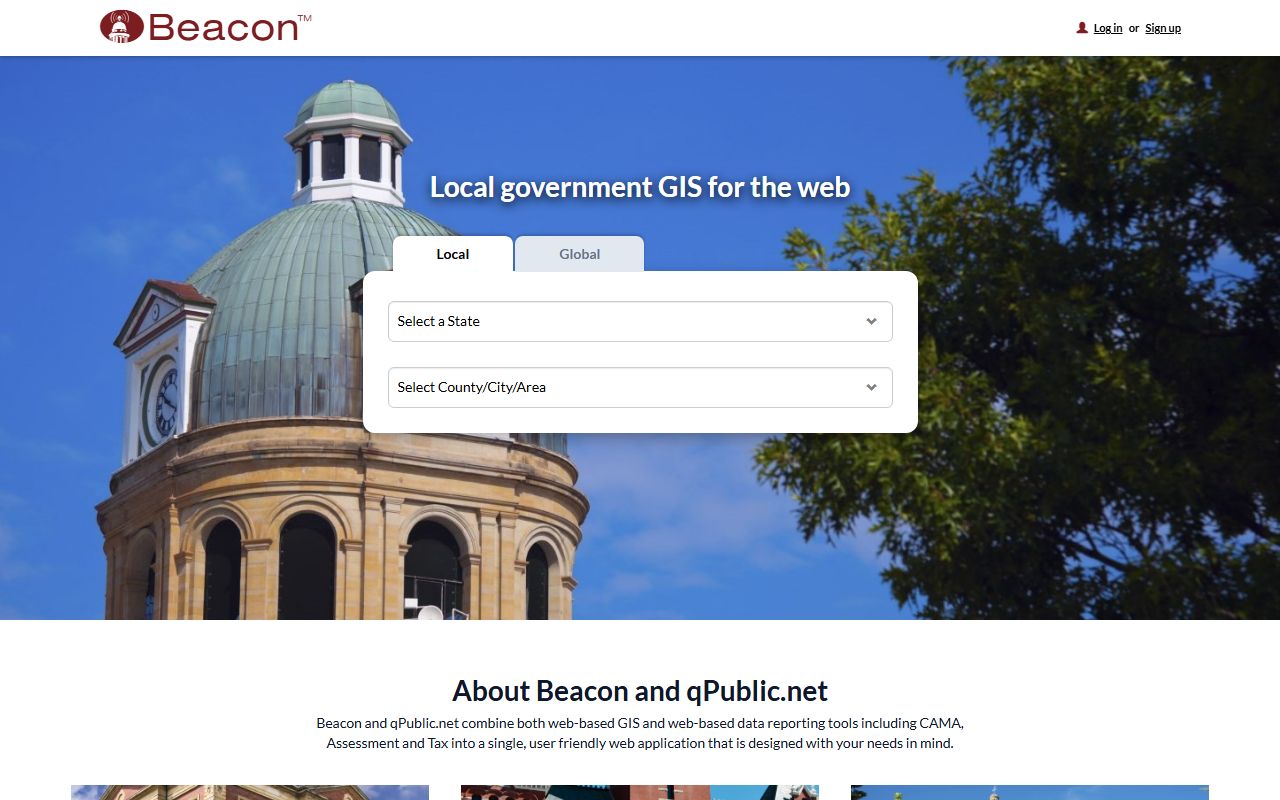
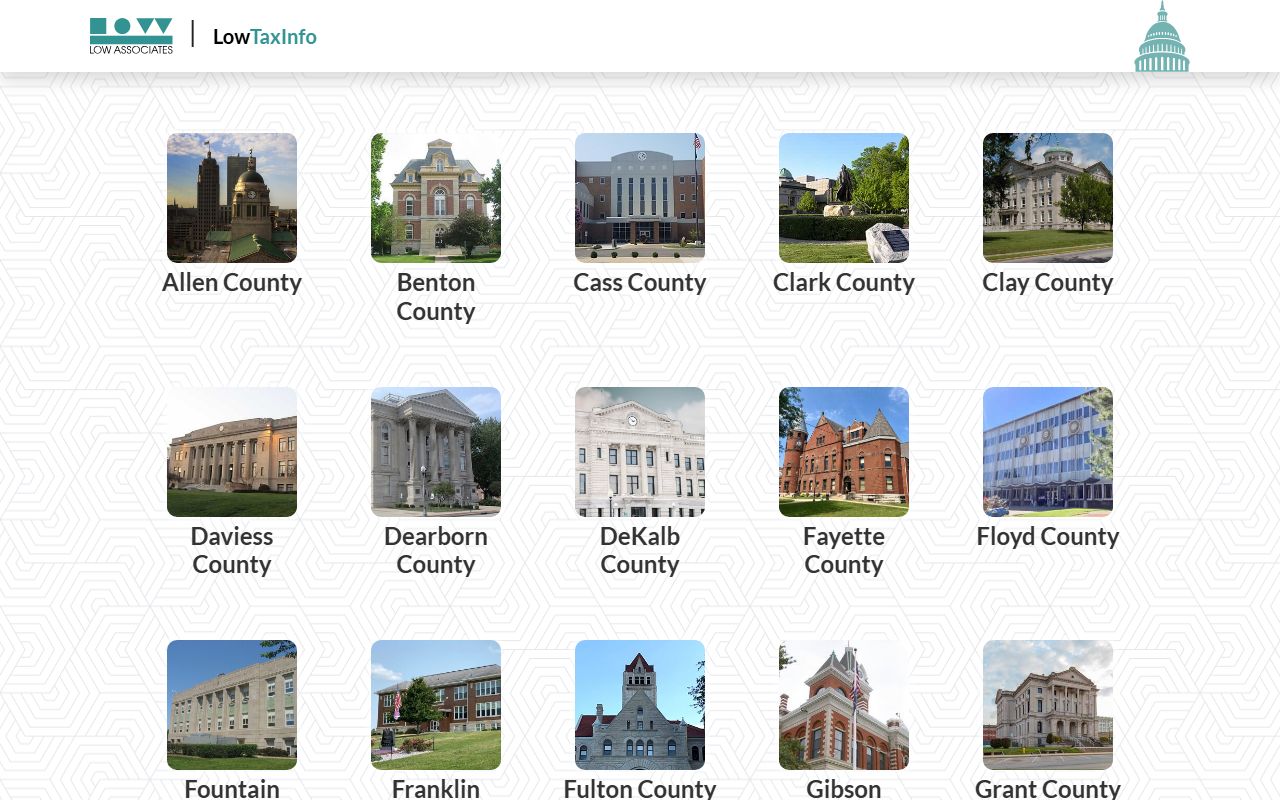
XSoft Engage is used by Lake, St. Joseph, Vanderburgh, Clark, DeKalb, Shelby, Warrick, and Knox counties. It provides assessment records and property data through a web-based interface. DataPitStop is the most common system among smaller Indiana counties. It follows a URL pattern of auditor.[countyname][number].us and is used by more than 50 counties statewide. LowTaxInfo.com is used by Monroe, Noble, Spencer, Parke, Putnam, Starke, Sullivan, and Vigo counties for payment history and billing data.
XSoft Engage provides property assessment and tax records for Lake, St. Joseph, Vanderburgh, Clark, and other Indiana counties.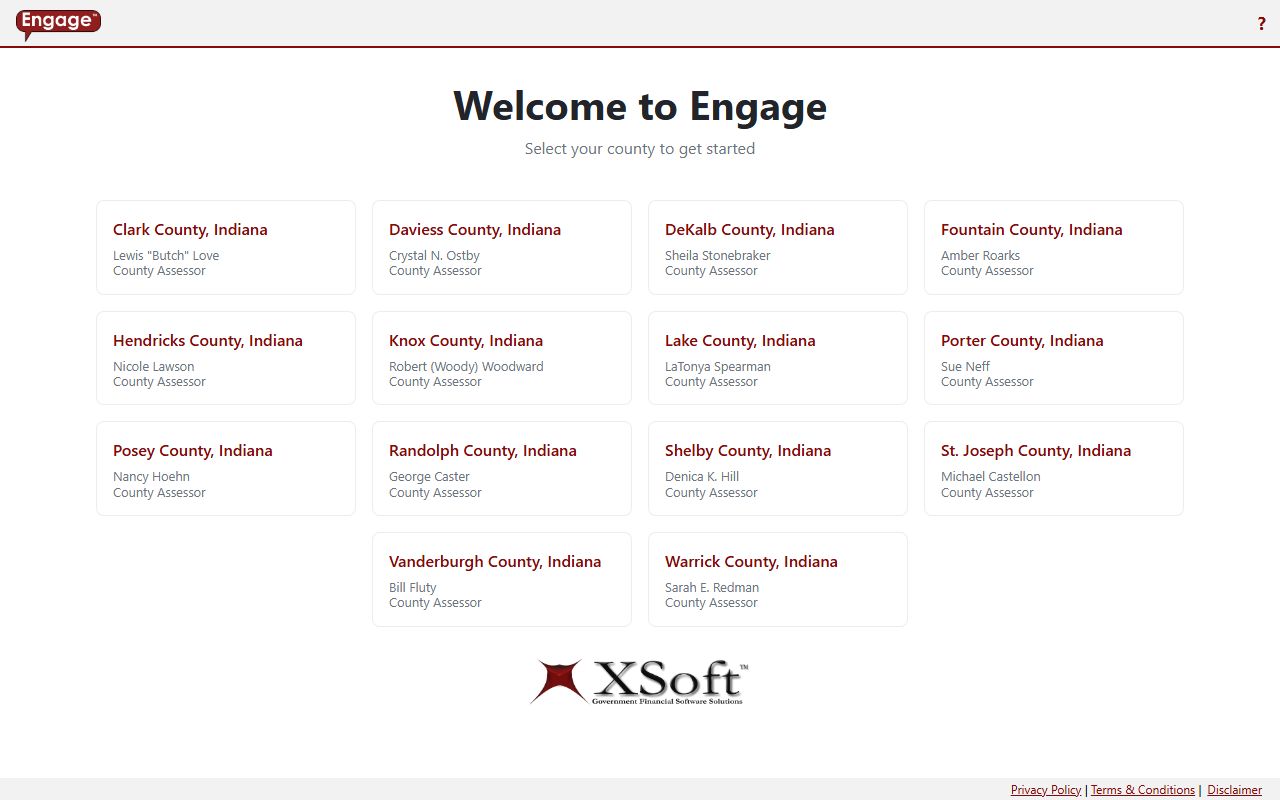 LowTaxInfo provides property tax payment history and bill data for Monroe, Noble, Spencer, Vigo, and other Indiana counties.
The full text of Indiana Code property tax law is publicly available through legal research sites. Indiana Code Title 6, Article 1.1 covers the complete property tax system, from assessment definitions to tax sale procedures and appeal rights.
Indiana Code Title 6, Article 1.1 covers all property tax law including assessments, deductions, billing, tax sales, and appeals.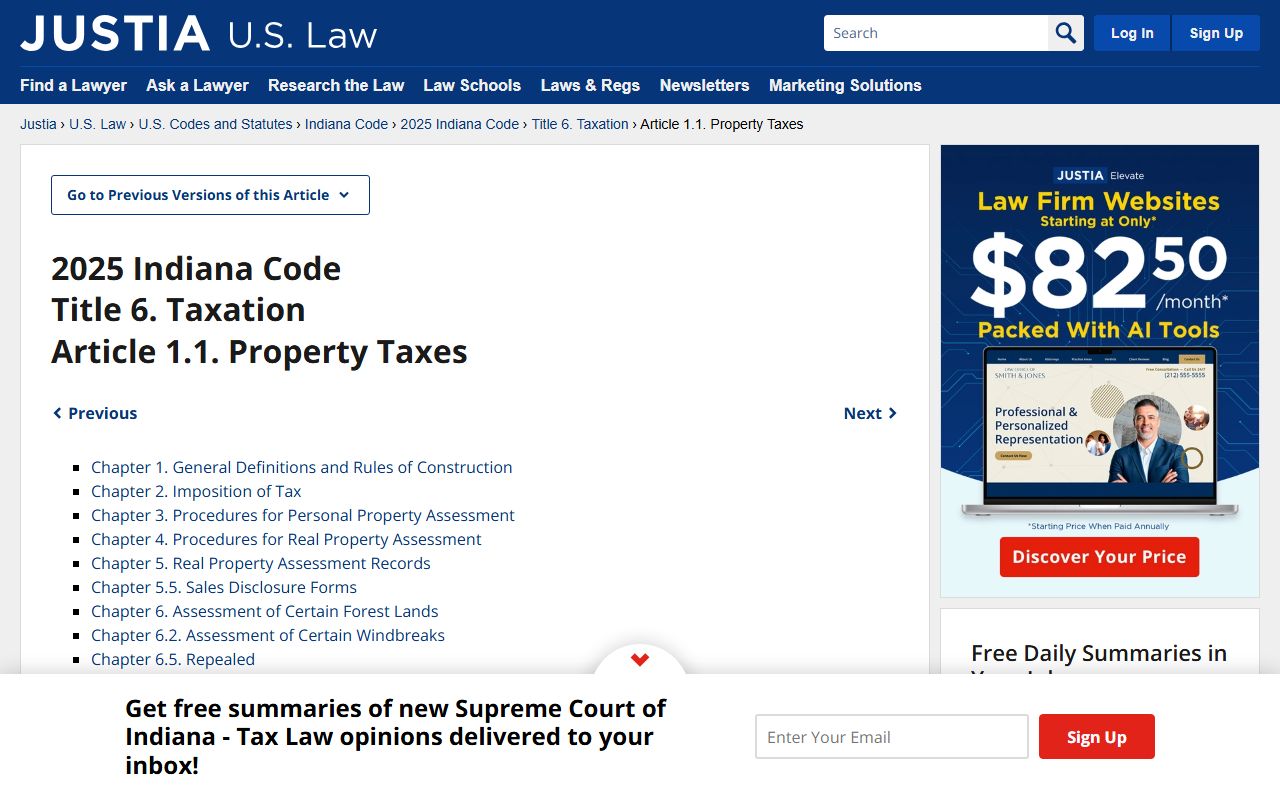
Browse Indiana Property Tax Records by County
Each of Indiana's 92 counties maintains its own property tax records. Select a county to find local office contact information, online search tools, and county-specific resources.
Indiana Property Tax Records by City
Indiana's largest cities use their county property tax systems. Select a city below to find property tax offices, online search portals, and payment information for that area.