
Access Grant County Property Tax Records
Grant County property tax records are maintained by the Auditor, Assessor, and Treasurer at 401 S. Adams Street in Marion. Auditor Angie Jarvis leads the office on the 2nd floor and oversees the county tax duplicate, deed transfers, and deduction filings. The county provides multiple online tools for property research, including a dedicated Auditor portal, a Treasurer lookup, a GIS system through Beacon, and a property tax calculator. Property assessments in Grant County are updated yearly from March 1st, and the GIS site includes ownership data, sales history going back to 2008, assessed values, and property sketches and photos.
Grant County Property Tax Quick Facts
Grant County Auditor Angie Jarvis
Grant County Auditor Angie Jarvis operates out of 401 S. Adams Street, 2nd Floor, Marion, IN 46953. The main office number is 765-668-6552, extension 3217. Jarvis handles the county tax duplicate, deed transfers, and all deduction filings. Her office's information is available at in.gov/counties/grant/county-offices/auditors-office. Office hours run Monday through Friday, 8 am to 4 pm.
The Transfer Deputy for the Grant County Auditor is Buffy McGinnis, reachable at extension 3204. If you are handling a deed transfer and need help with the paperwork or process, McGinnis is the right contact. Deed transfers must go through the Auditor's office before deductions from the prior owner are cleared from the record. When you buy a home in Marion or anywhere in Grant County, check the deduction status and file fresh applications for any you qualify for.
The Grant County Treasurer is at 401 S. Adams St., Marion, IN 46952, and can be reached at 765-668-6556. The Treasurer handles all payment processing and maintains payment history for each parcel. The Assessor's office phone is (765) 668-4773 and covers questions about how individual property values were determined.
Grant County Online Property Search Tools
Grant County offers several online tools for property tax research. The Auditor portal at auditor.grantcounty27.us allows searches by parcel number, owner last name, or address. The Treasurer also maintains a separate lookup at treasurer.grantcounty27.us for payment history and current balances. Having two separate portals gives Grant County property owners more ways to check on their accounts. Use the Auditor portal for assessment and deduction data, and the Treasurer portal for payment history and balance information.
Grant County also uses the Beacon GIS system for parcel mapping. According to county information, the GIS site "provides property location, ownership, sales history from 2008, assessed values, land and improvement info, sketches and photos." This makes Beacon especially useful for a fuller picture of a property's history and current status. The Beacon platform for Grant County is accessible through beacon.schneidercorp.com. In addition, the Auditor's website lists GIS and Property Owner Information as a resource under its links and tools. The statewide Indiana Gateway Tax Bill Lookup is another backup option that covers all 92 Indiana counties.
Property assessments in Grant County are updated yearly from March 1st. If you check the GIS or Auditor portal around that time, values may be in the process of updating.
Grant County Property Tax Calculator
The Grant County Auditor's office provides a property tax calculator on its website. This tool is listed as one of the resources available to county property owners and allows you to estimate your tax bill based on assessed value and applicable tax rates. It is not a substitute for the official bill, but it can help you plan ahead and understand roughly what to expect before bills are mailed. The calculator is available through the Auditor's page at in.gov/counties/grant.
Property Tax Deductions in Grant County
Indiana Code IC 6-1.1-12 provides the framework for all property tax deductions available to Grant County property owners. Applications go to Auditor Angie Jarvis at 401 S. Adams Street, 2nd Floor, Marion. The homestead deduction is the most commonly used. It applies to a property that you own and use as your primary residence. The supplemental homestead deduction layers on top of the base amount, so both are worth filing for at the same time.
Additional deductions under Indiana law are available for a range of situations. The Over 65 deduction applies if you meet the age and income requirements set by Indiana code. The Over 65 Circuit Breaker caps tax increases once you qualify, providing ongoing protection. Blind or disabled property owners can apply for their own deduction category. Veterans with total service-connected disabilities qualify for the Totally Disabled Veteran deduction, which can significantly reduce a bill. Property owners who have installed geothermal heating or solar panels may also qualify for an energy deduction. All applications must be filed with the Grant County Auditor by January 5. Missing the deadline means waiting another full year for the benefit to take effect.
Deductions tied to a prior owner do not transfer when a property is sold. New Grant County property owners must re-file any deductions they qualify for. The Auditor's office at extension 3217 can help you identify what to file and provide the forms you need.
Assessment and Appeals in Grant County
The Grant County Assessor sets property values as of January 1 each year under IC 6-1.1-4. Values are set at market value for most property types, and land and improvements are valued separately. The Assessor's office updates assessments yearly from March 1st. Each spring, property owners receive a Form 11 notice with the new assessed value. Review this carefully, as it sets the taxable base for the next billing cycle.
If you believe your Grant County assessed value is too high, you can appeal under IC 6-1.1-35. Call the Assessor at (765) 668-4773 first for an informal review. Many disputes end here. If not, file Form 130 with the Grant County Property Tax Assessment Board of Appeals by June 15. The PTABOA holds a hearing and issues a decision. Further appeal options include the Indiana Board of Tax Review and, finally, the Indiana Tax Court. The DLGF at in.gov/dlgf publishes a full guide to the appeal process and what evidence tends to carry weight at each stage.
Tax Payment Due Dates and Penalties
Grant County property taxes are due in two installments. Spring payments are due May 10 and fall payments are due November 10. The Treasurer at 401 S. Adams St. in Marion handles all payments. Use the Treasurer's online portal or call 765-668-6556 to confirm your current balance before mailing a check. The Indiana Gateway Tax Bill Lookup also shows current bill amounts for all Grant County parcels.
A 5% penalty applies to any amount unpaid within 30 days after the due date. After 30 days, the penalty rises to 10%. Both amounts are added to the base balance. Ongoing nonpayment can trigger a tax sale process under IC 6-1.1-22. Contact the Treasurer early if you think you will miss a due date. The county Indiana Tax Forms link on the Auditor's website, which includes DLGF forms, is another useful resource for understanding your obligations and options.
Grant County Auditor Records Screenshot
The Grant County Auditor's office page at in.gov/counties/grant lists all staff contacts, office tools, and resources including the property tax calculator and GIS links for Marion and all of Grant County.
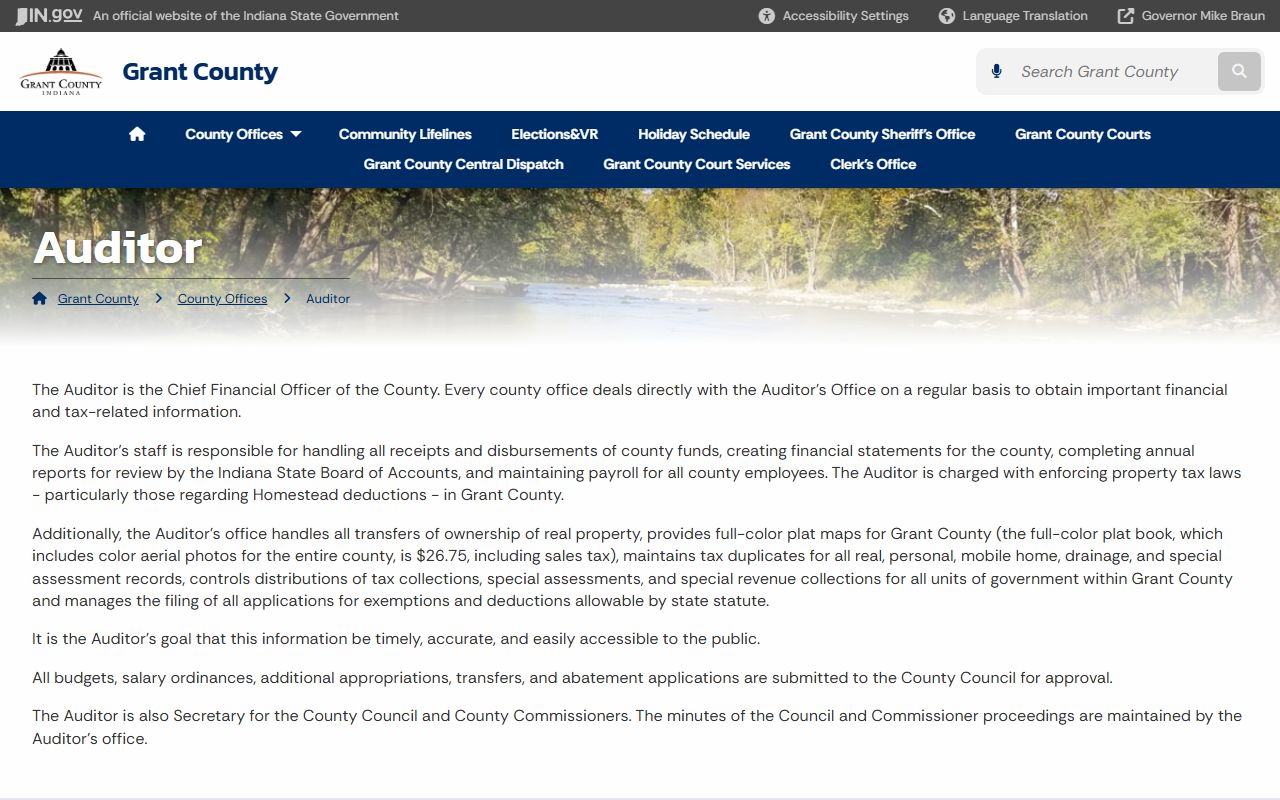
Auditor Angie Jarvis and Transfer Deputy Buffy McGinnis handle deed transfers and deduction filings from the 2nd floor at 401 S. Adams Street in Marion.
Cities in Grant County
Marion is the county seat and the largest city in Grant County. Property tax records for all parcels in Marion are held by the Grant County Auditor, Assessor, and Treasurer at 401 S. Adams Street.
Nearby Counties
Grant County is in north-central Indiana and shares borders with seven counties. All have their own Auditor offices and online property tax search tools.