
Wabash County Property Tax Records Search
Wabash County property tax records are managed by the Wabash County Assessor, Auditor, and Treasurer in Wabash, Indiana, and property owners can search parcel data, assessed values, deduction status, and tax billing information through county offices and state online tools under oversight from the Indiana Department of Local Government Finance. Wabash County is in north-central Indiana and is the county seat of the city known as the first electrically lit city in the world, a detail that distinguishes the area while its property tax system follows the same Indiana rules as every other county.
Wabash County Property Tax Quick Facts
Wabash County Assessor, Auditor, and Treasurer
Wabash County follows Indiana's standard three-office model for property tax administration. The Assessor values all real property in the county as of January 1 each year under IC 6-1.1-4. The Auditor applies approved deductions and calculates the net annual tax for each parcel. The Treasurer issues bills and handles all collections, including online payments and delinquent accounts.
All three offices are at the Wabash County Courthouse in Wabash. The courthouse is where property owners go to file deductions, transfer ownership records, ask about tax bills, or make payments in person. Wabash County's location in north-central Indiana places it within the Beacon GIS coverage area, which is commonly used in this part of the state for parcel search and tax data.
The Wabash County Auditor handles all deduction applications. Homestead deductions, over-65 exemptions, veteran deductions, and other Indiana programs are all filed here. The January 5 deadline to submit or change any deduction applies in Wabash County the same as everywhere in Indiana under IC 6-1.1-12. New property owners should file the homestead deduction as soon as the sale closes.
Wabash County Property Tax Records Online
The Indiana DLGF homepage shown below provides the regulatory framework for all Wabash County property tax processes, including assessment rules, deduction programs, tax caps, and the appeal procedures that apply across Indiana.

The DLGF site at in.gov/dlgf includes a free assessed value search tool that covers every Indiana parcel including those in Wabash County, along with taxpayer guides and downloadable forms.
The Beacon GIS platform at beacon.schneidercorp.com is widely used in north-central Indiana and provides parcel mapping and property data for Wabash County. You can search by owner name, address, or parcel number and view assessed values, parcel maps, and tax data. The statewide Indiana Gateway Tax Bill Lookup provides another way to check current balances for any Wabash County parcel.
The Indiana Gateway Taxpayer Portal shows levy and budget data for all Wabash County taxing units, including the county government, townships, school corporations, and municipalities. This data is publicly accessible at no cost and shows how the combined levies of multiple local government bodies produce the total tax rate for any parcel in the county.
Wabash County Property Tax Deductions
Indiana law provides several deduction programs that reduce the taxable assessed value of Wabash County property before tax rates are applied. The Homestead Standard Deduction and Homestead Supplemental Deduction are the most commonly used programs and apply to owner-occupied primary residences. Together they represent the largest potential reduction for most residential property owners in the county.
Other deductions available through the Wabash County Auditor include the Over 65 Deduction for qualifying senior owners, the Over 65 Circuit Breaker Credit, the Blind or Disabled Deduction, and the Totally Disabled Veteran Deduction. Indiana also offers deductions for geothermal energy systems and solar installations. Each program has specific eligibility requirements. The Auditor can explain what is currently on file for any parcel and what documentation is needed for a new application.
Indiana's constitutional circuit breaker caps also protect Wabash County property owners. Homestead residential parcels are capped at 1% of assessed value per year. Other residential property caps at 2%, and commercial or agricultural land caps at 3%. These limits apply regardless of how many taxing units levy against a given parcel, providing a hard ceiling on the total annual tax bill. The governing statute is IC 6-1.1-12.
Assessment and Appeals in Wabash County
Wabash County real property is assessed at 100% of market value as of January 1 each year. The county's mix of residential properties in the city of Wabash, agricultural land in the townships, and some industrial and commercial parcels is each assessed under the method appropriate to its type. Indiana's uniform market value standard applies here as it does in all 92 counties.
To challenge a Wabash County assessed value, file Form 130 with the county by June 15 of the assessment year. The Wabash County Property Tax Assessment Board of Appeals handles the first level of review. If the result is not satisfactory, the property owner can file with the Indiana Board of Tax Review. The full appeal framework is set by IC 6-1.1-35.
The Indiana DLGF at (317) 232-3777 provides guidance on the appeal process and taxpayer rights for all Indiana counties. For questions about a specific Wabash County parcel's valuation, contact the county Assessor's Office directly in Wabash.
Tax Payments and Due Dates in Wabash County
The Indiana Gateway Taxpayer Portal shown below provides levy and budget information for all Wabash County taxing units, which helps property owners understand how the total tax rate on their parcel is built from multiple overlapping local levies.
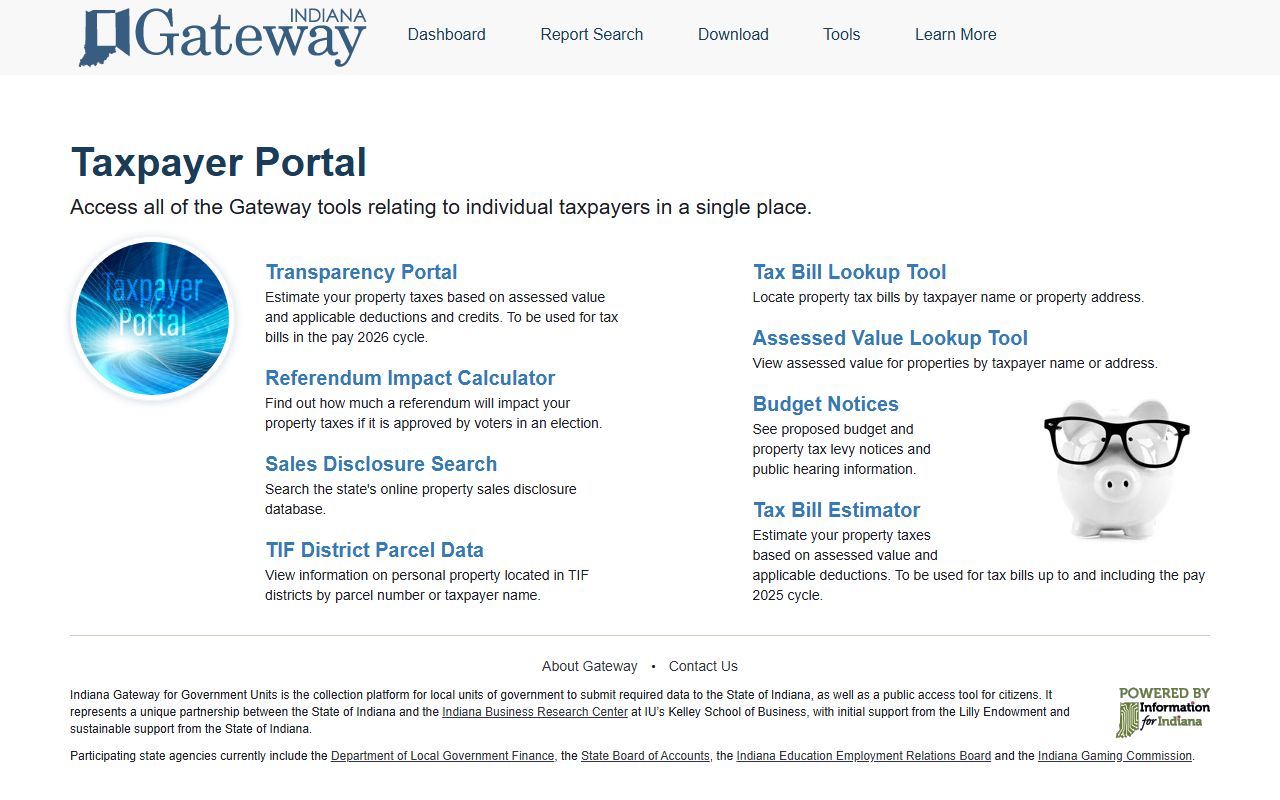
The portal shows how Wabash County's county, township, school, and municipal levies contribute to the total property tax rate for any parcel, and all data is free and publicly accessible.
Wabash County tax bills are mailed in early April. The spring installment is due May 10 and the fall installment is due November 10. These dates apply statewide in Indiana. A 5% penalty applies to overdue amounts within the first 30 days after the due date, increasing to 10% after 30 days. Billing follows IC 6-1.1-22.
Continued non-payment of Wabash County property taxes can lead to a tax lien and eventual county tax sale under IC 6-1.1-24. Indiana provides a redemption period after a tax sale during which the original owner can pay the delinquent amount plus fees to recover the property. For balance information or payment options, contact the Wabash County Treasurer in Wabash.
Nearby Counties
Wabash County is in north-central Indiana and borders several counties that each maintain their own property tax records and assessment systems.